The National Identityof thePhilippines
Explore the official national symbols of the Philippines, their history, origins, meanings, and significance.
Icons of the Filipino Nation
These official symbols represent the soul, strength, and beauty of the Philippines — chosen to embody the values, heritage, and natural wonders of the Filipino people. Click any card to explore its full history, origin, and significance.
 National Flag
Pambansang Watawat
The Flag of the Philippines
The Philippine flag was designed by General Emilio Aguinaldo and first unfurled on June 12, 1898 in Kawit, Cavite, during the proclamation of Philippine independence. It was sewn by Marcela Agoncillo, her daughter Lorenza, and Delfina Herbosa de Natividad in Hong Kong. The flag was officially adopted by the Malolos Congress in 1899.
 National Anthem
Lupang Hinirang
Chosen Land
The music was composed by Julian Felipe in 1898 and originally titled Marcha Nacional Filipina. It was first performed on June 12, 1898 during the proclamation of independence. The Spanish lyrics were written by Jose Palma in 1899 as a poem titled Filipinas, later set to Felipe's music. The official Filipino translation was adopted in 1956.
 National Hero
Jose Protacio Rizal
Mercado y Alonso Realonda
Jose Rizal was born in Calamba, Laguna on June 19, 1861. A polymath — novelist, poet, ophthalmologist, sculptor, painter, educator, and political activist — he wrote two landmark novels (Noli Me Tangere and El Filibusterismo) that exposed the abuses of Spanish colonial rule and ignited the Philippine Revolution. He was executed by firing squad at Bagumbayan (now Luneta Park) on December 30, 1896, at age 35.
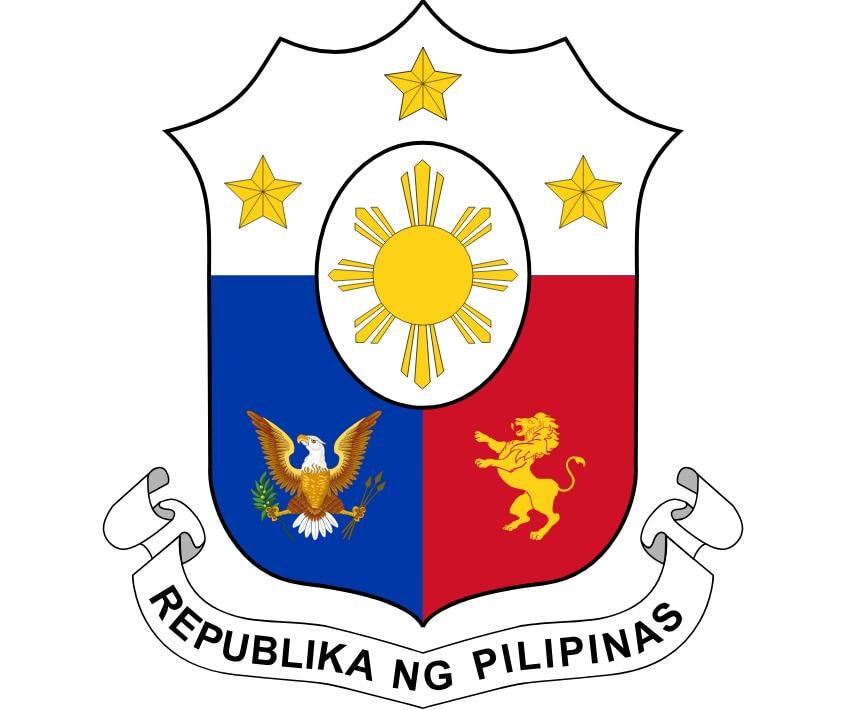 National Seal
Great Seal of the Philippines
Sagisag ng Pilipinas
The Philippine coat of arms has evolved through several versions. The current design was established after independence in 1946. It incorporates elements from the Spanish colonial period (the lion and castle) and the American period (the eagle), unified under a Philippine sun and stars.
 National Motto
Maka-Diyos, Maka-Tao, Makakalikasan at Makabansa
For God, People, Nature, and Country
The current national motto was adopted in 1998 under President Fidel Ramos. It replaced the earlier motto Isang Bansa, Isang Diwa (One Nation, One Spirit). The motto is enshrined in the Philippine Constitution and is the guiding principle of the Department of Education's core values.
 National Language
Filipino
Based on Tagalog
The national language question has been debated since independence. In 1937, the Institute of National Language selected Tagalog as the basis for a national language. In 1959, it was renamed Pilipino, and in 1987, the Constitution renamed it Filipino — a more inclusive term that acknowledges contributions from all Philippine languages.
 National Tree
Narra
Pterocarpus indicus
The narra was declared the national tree in 1934 during the Commonwealth period. It was chosen for its strength, beauty, and widespread presence throughout the Philippine archipelago. The narra has been used by Filipinos for centuries in furniture-making, construction, and traditional medicine.
 National Animal
Carabao
Bubalus bubalis carabanesis
The carabao (water buffalo) has been the backbone of Philippine agriculture for over 3,000 years. Introduced from mainland Asia, it became indispensable to Filipino farmers for plowing rice fields, hauling loads, and providing milk and meat. It was officially declared the national animal in 1997.
 National Bird
Philippine Eagle
Pithecophaga jefferyi
The Philippine Eagle was declared the national bird by President Fidel Ramos in 1995, replacing the Maya (Eurasian tree sparrow). It was first scientifically described in 1896 by British ornithologist William Robert Ogilvie-Grant. The eagle is endemic to the Philippines, found only in the forests of Luzon, Leyte, Samar, and Mindanao.
 National Flower
Sampaguita
Jasminum sambac
The sampaguita was declared the national flower in 1934, the same year as the narra tree. It has been cultivated in the Philippines for centuries and is deeply woven into Filipino religious and social life. The flower was likely introduced from India or Arabia, but has been naturalized in the Philippines for so long it is considered a native symbol.
 National Fish
Bangus
Chanos chanos (Milkfish)
The bangus (milkfish) was declared the national fish in 1955. It has been farmed in the Philippines for over 800 years — one of the oldest aquaculture traditions in the world. The bangus industry is centered in Dagupan City, Pangasinan, which holds an annual Bangus Festival every May.
 National Fruit
Mangga
Mangifera indica (Philippine Mango)
The Philippine mango was declared the national fruit in 1995. The Philippines has been cultivating mangoes for centuries, and the Philippine variety — particularly the Carabao mango — is internationally recognized as the sweetest mango in the world. In 1995, the Guinness Book of World Records certified the Philippine Carabao mango as the sweetest mango variety.
 National Leaf
Anahaw
Livistona rotundifolia (Fan Palm)
The anahaw was declared the national leaf in 1934. It is a species of fan palm native to the Philippines and Southeast Asia. The anahaw leaf has been used by Filipinos for centuries as roofing material, fans, baskets, and decorative items. It is one of the most recognizable plants in the Philippine landscape.
 National Gem
Philippine Pearl
South Sea Pearl (Pinctada maxima)
The Philippine Pearl was declared the national gem in 1996. The Philippines is one of the world's leading producers of South Sea pearls, the largest and most valuable type of pearl. The Pearl of Lao-tzu (also called the Pearl of Allah), found in Palawan in 1934, was for decades considered the largest pearl in the world at 6.4 kg.
 National Sport
Arnis
Eskrima / Kali — Filipino Martial Art
Arnis (also known as Eskrima or Kali) was declared the national martial art and sport in 2009. It is one of the oldest martial arts in Asia, predating Spanish colonization. When Magellan arrived in 1521, Lapu-Lapu's warriors used bladed weapons and fighting techniques that are the ancestors of modern Arnis. The Spanish colonizers attempted to ban the practice, but Filipinos preserved it by disguising it as folk dance.
Showing 15 of 15 national symbols
The Soul of the Filipino People
Filipino culture is a vibrant tapestry woven from thousands of years of indigenous tradition, centuries of Spanish and American influence, and the enduring spirit of a people who have always found joy, beauty, and meaning in community.
The Philippines is the only predominantly Christian nation in Asia, with approximately 86% of the population identifying as Roman Catholic. This deep Catholic faith, introduced by Spanish missionaries in the 16th century, has profoundly shaped Filipino culture, values, family life, and national identity.
Simbang Gabi
Nine pre-dawn Masses held from December 16-24, one of the most beloved Filipino Catholic traditions. Families wake before dawn to attend Mass together, followed by traditional holiday foods like bibingka and puto bumbong.
Semana Santa
Holy Week (the week before Easter) is the most solemn period in the Filipino Catholic calendar. Processions, the Salubong (Easter dawn meeting of Christ and Mary), and the Senakulo (Passion play) are observed nationwide.
Feast Days
Every Filipino town has a patron saint whose feast day is celebrated with a fiesta — a community celebration featuring food, music, dancing, and religious processions. Fiestas are the heartbeat of Filipino community life.
Bangsamoro Islam
The Muslim communities of Mindanao and the Sulu Archipelago have practiced Islam since the 14th century — predating Spanish colonization. The Bangsamoro Autonomous Region preserves this rich Islamic heritage and culture.
The Heart of the Nation
The Filipino people are the Philippines' greatest treasure — 115 million individuals across 7,641 islands, united by shared values, a rich heritage of indigenous cultures, and the indomitable spirit that has carried the nation through centuries of challenge.
Family Above All
Pamilya
The Filipino family is the fundamental unit of society. Filipinos maintain close ties with extended family — grandparents, aunts, uncles, and cousins are considered immediate family. Major life decisions are made with the family's welfare in mind. The concept of the family extends to godparents (ninong/ninang) through the compadrazgo system.
Respect for Elders
Paggalang sa Matatanda
Respect for elders is one of the most visible Filipino values. The pagmamano gesture (pressing an elder's hand to one's forehead), the use of po and opo (honorific particles in speech), and the practice of asking for an elder's blessing (mano po) are daily expressions of this deep respect.
Communal Spirit
Bayanihan
Bayanihan — the spirit of communal unity and cooperation — is the Filipino ideal of helping one another without expectation of reward. It manifests in community disaster response, neighborhood cooperation, and the Filipino tradition of helping family members in need regardless of personal cost.
Resilience
Katatagan
Filipinos are renowned worldwide for their resilience in the face of adversity. Living in one of the world's most disaster-prone countries — facing typhoons, earthquakes, and volcanic eruptions — Filipinos have developed an extraordinary capacity to rebuild, adapt, and find joy even in hardship.
Hospitality
Pagkamapagpatuloy
Filipino hospitality is legendary. Guests are always offered food, even when resources are scarce. The phrase kain na (let's eat) is one of the most common Filipino greetings. A Filipino home is always open, and visitors are treated as honored guests regardless of the host's circumstances.
Sense of Humor
Pagiging Masaya
Filipinos are known for their ability to laugh in the face of hardship — a coping mechanism that has sustained the nation through centuries of colonization, natural disasters, and political turmoil. Filipino humor is warm, self-deprecating, and deeply communal.
Pearl of the Orient Seas
An archipelago of 7,641 islands stretching 1,850 kilometers from north to south, the Philippines is one of the most geographically diverse nations on Earth — from the rice terraces of the Cordillera to the coral reefs of Palawan, from the volcanic peaks of Bicol to the white sand beaches of the Visayas.

Philippine Archipelago
7,641 Islands · Southeast Asia
Location & Climate
The Philippines lies between 4°N and 21°N latitude, in the western Pacific Ocean. It is bounded by the South China Sea to the west, the Philippine Sea to the east, and the Celebes Sea to the south. The country has a tropical maritime climate with three seasons: tag-init (dry season, March-May), tag-ulan (rainy season, June-November), and tag-lamig (cool dry season, December-February).
Biodiversity Hotspot
The Philippines is one of the world's 17 megadiverse countries and one of only 5 countries classified as both a megadiverse country and a biodiversity hotspot. It is home to over 52,177 described species, of which more than half are found nowhere else on Earth. The Philippine Eagle, the tarsier, the tamaraw, and the Philippine crocodile are among its most iconic endemic species.
Ring of Fire
The Philippines sits on the Pacific Ring of Fire, making it one of the most geologically active countries in the world. It has 24 active volcanoes, including Mayon (the most active), Taal (one of the world's smallest active volcanoes), and Pinatubo (whose 1991 eruption was the second-largest of the 20th century). The country experiences an average of 20 typhoons per year.
Maritime Heritage
With the fifth-longest coastline in the world (36,289 km), the Philippines has always been a maritime nation. The Sulu and Celebes Seas were among the most active trade routes in pre-colonial Southeast Asia. Today, the Philippines is one of the world's largest suppliers of seafarers, with over 400,000 Filipino sailors working on international vessels.
A History Forged in Courage
From the ancient Austronesian settlers to Spanish colonization, American occupation, and hard-won independence — the Filipino people have shaped a resilient national identity across centuries of struggle and triumph.
Key Historical Moments
Laguna Copperplate Inscription — earliest known written record in the Philippines
Ferdinand Magellan arrives; Battle of Mactan — Lapu-Lapu defeats Spanish forces
Spanish colonial rule begins under Miguel López de Legazpi
Philippine Revolution — Andres Bonifacio leads the Katipunan uprising
Declaration of Philippine Independence on June 12 in Kawit, Cavite
Full independence from the United States — the Third Philippine Republic proclaimed
A Culture Woven in Color
Language
Filipino (based on Tagalog) is the national language, alongside English as co-official. Over 180 regional languages are spoken across the archipelago, including Cebuano, Ilocano, and Hiligaynon.
Religion & Faith
The Philippines is the only predominantly Christian nation in Asia, with over 80% Catholic. Islam is practiced in Mindanao, and indigenous spiritual traditions remain alive in highland communities.
Arts & Music
From the haunting kundiman love songs to the vibrant rondalla ensemble, Philippine arts blend indigenous, Spanish, and Asian influences. The parol (Christmas lantern) and weaving traditions are UNESCO-recognized.
Cuisine
Adobo, sinigang, lechon, and kare-kare — Filipino cuisine is a bold fusion of Malay, Chinese, Spanish, and American flavors, celebrated for its balance of sour, salty, and savory notes.
Festivals
The Philippines is the land of fiestas. Sinulog, Ati-Atihan, Pahiyas, and Kadayawan are among hundreds of festivals that fill the streets with color, music, and communal joy every year.
Values That Define a People
At the heart of Filipino identity are deeply held values that have sustained communities through hardship and celebration alike.
Bayanihan
The spirit of communal unity — neighbors helping neighbors, communities lifting each other. Bayanihan is the living soul of Filipino society.
Malasakit
Genuine care and compassion for others. Malasakit drives Filipinos to look after family, community, and even strangers in times of need.
Pagmamahal sa Bayan
Love of country. From José Rizal's sacrifice to everyday acts of civic pride, love for the Philippines runs deep in every Filipino heart.
Voices of the Nation
The youth is the hope of our future.
It is a happy fate to fight for one's country.
The Filipino is worth dying for.
The Philippine Story Through Time
From ancient civilizations to modern democracy — a chronological journey through the defining moments that shaped the Filipino nation.
First Inhabitants
The Aeta people, believed to be the first inhabitants of the Philippines, arrive via land bridges from mainland Asia during the last Ice Age.
Laguna Copperplate
The Laguna Copperplate Inscription — the oldest known written document found in the Philippines — is created, showing trade links with Java and India.
Magellan & Lapu-Lapu
Ferdinand Magellan arrives and is killed at the Battle of Mactan by Datu Lapu-Lapu, the first Filipino hero to resist foreign colonization.
333 Years of Spanish Rule
Spain colonizes the Philippines for over three centuries, introducing Christianity, the encomienda system, and a centralized government — reshaping Filipino society profoundly.
Katipunan Revolution
Andres Bonifacio founds the Katipunan and leads a mass uprising against Spanish rule. The revolution marks the birth of Filipino nationalism.
Independence Declared
General Emilio Aguinaldo declares Philippine independence in Kawit, Cavite. The Philippine flag is unfurled for the first time and Lupang Hinirang is played.
American Colonial Period
Following the Spanish-American War, the Philippines is ceded to the United States. The Americans introduce public education, English as medium of instruction, and democratic institutions.
Full Independence
The Philippines gains full independence from the United States. Manuel Roxas becomes the first president of the Third Philippine Republic.
People Power Revolution
The peaceful EDSA People Power Revolution ousts Ferdinand Marcos after 21 years of authoritarian rule, restoring democracy and inspiring the world.
A Nation Rising
The Philippines stands as a vibrant democracy of over 100 million people — a nation of resilience, creativity, and enduring hope for the future.
7,641 Islands of Beauty
Luzon
The largest island, home to Metro Manila, the Cordillera highlands, Mayon Volcano, and the UNESCO-listed Banaue Rice Terraces.
Visayas
The central island group, known for pristine beaches, the Chocolate Hills of Bohol, Cebu's heritage, and world-famous dive sites.
Mindanao
The second-largest island, rich in indigenous cultures, Mount Apo (the highest peak), Lake Lanao, and the vibrant Kadayawan festival.
Did You Know?
Fascinating facts about the Philippines that might surprise you.
Tap any card to reveal the answer
Sources & Further Reading
This educational resource draws exclusively from authoritative Philippine government agencies, official records, and recognized academic institutions.
Official Gazette of the Republic of the Philippines
Primary source for Republic Acts, Executive Orders, proclamations, and official government records — including legislation on national symbols and state affairs.
National Historical Commission of the Philippines (NHCP)
The primary government agency for Philippine history, historical research, preservation of heritage sites, and authentication of historical facts and markers.
National Commission for Culture and the Arts (NCCA)
The government body mandated to preserve and promote Philippine arts, culture, and intangible cultural heritage, including festivals, traditions, and indigenous practices.
Department of Tourism — Republic of the Philippines
Official source for Philippine tourism data, heritage destinations, natural wonders, UNESCO-recognized sites, and regional cultural information.
Philippine Statistics Authority (PSA)
The central statistical authority of the Philippine government, providing official data on population, demographics, languages, and socioeconomic indicators.
National Library of the Philippines
Repository of Philippine literary heritage, historical documents, rare manuscripts, and archival materials essential to the study of Filipino national identity.
Komisyon sa Wikang Filipino (KWF)
The constitutional body responsible for the development, preservation, and promotion of Filipino as the national language of the Philippines.
National Cultural Heritage Act — Republic Act No. 10066
The law governing the protection, preservation, and conservation of the national cultural heritage of the Philippines, administered by the NCCA and NHCP.
Republic Act No. 8491 — Flag and Heraldic Code of the Philippines
The official law prescribing the code of the national flag, anthem, motto, coat-of-arms, and other national symbols of the Republic of the Philippines.
Commission on Filipinos Overseas (CFO)
Government agency providing data and programs for the Filipino diaspora, overseas Filipinos, and their contributions to national identity and development.
National Commission on Indigenous Peoples (NCIP)
The primary government agency that formulates and implements policies for the recognition, protection, and promotion of the rights of indigenous cultural communities.
Philippine Eagle Foundation
The leading conservation organization dedicated to the protection of the Philippine Eagle — the national bird — and its critical forest habitat.
Get in Touch
Have questions, suggestions, or want to contribute to this educational resource? We'd love to hear from you.
One Nation.
One Spirit.
One People.
Across 7,641 islands, through centuries of history, in every language and every festival — the Filipino identity endures. It is a story of resilience, of beauty, of an unbreakable spirit that continues to inspire the world.
Mabuhay ang Pilipinas — Long live the Philippines